



On Wednesday, the dome on Saadiyat turned its gaze seaward. Spices and Wonders: Sailing the Indian Ocean, now open at Louvre Abu Dhabi and running until 14 February 2027, charts roughly a thousand years of maritime exchange — from Antiquity to the seventeenth century — across the ocean that made the Gulf a crossroads long before oil did.
Mounted in partnership with the National Museum of Asian Arts – Guimet in Paris, the exhibition follows the sea routes that stitched together the coasts of Africa, the Middle East and Europe with South and Southeast Asia. Its cargo is the stuff of legend made tangible: spices and textiles, ceramics and the recovered treasures of ships that never made harbour. There is navigation by the stars, the slow mathematics of the monsoon, and the quieter freight that travelled with every hull — ideas, faiths, tastes, and the habit of looking outward.
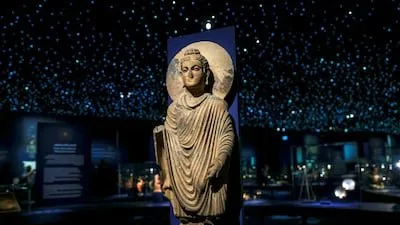
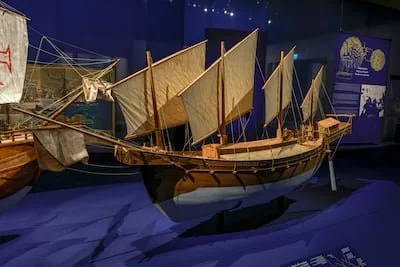
The curatorial pairing is a meeting of institutions as much as of minds: Dr Guilhem André, Louvre Abu Dhabi’s director of scientific, curatorial and collections management, works alongside Dr Claire Déléry, curator of the Guimet’s celebrated Chinese ceramics collection — a telling appointment, since no object tells the Indian Ocean story quite like a Chinese bowl unearthed from an Arabian wreck. After its Abu Dhabi run, the exhibition sails on to Paris, where the Guimet will present a second edition from May 2027.
The timing could hardly be better. Spices and Wonders opens the most ambitious stretch of Louvre Abu Dhabi’s 2026–2027 season, with the sixth Art Here exhibition and its Richard Mille Art Prize following in November, and a tenth-anniversary collaboration with the ALIPH Foundation on protecting heritage in crisis zones arriving later the same month. For the emirate, the autumn calendar is beginning to read like a manifesto.
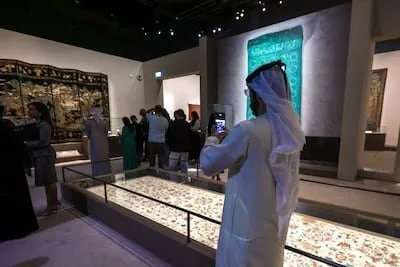
For Gulf audiences, though, this is more than programming. The Indian Ocean trade is the region’s own origin story — the pearls, the dhows, the harbour towns that grew into capitals. To walk these galleries is to be reminded that the Gulf’s current role as a meeting place of East and West is not an invention of the jet age, but a revival.

