



There are logos, and then there are signatures. Breitling’s Twin Jet — two stylised aircraft climbing in formation, introduced in 1957 and first set upon a Navitimer dial in 1965 — belongs firmly to the second category, and this month it returns to the brand’s regular collection on a pair of manually wound chronographs that read like love letters to the 1960s.
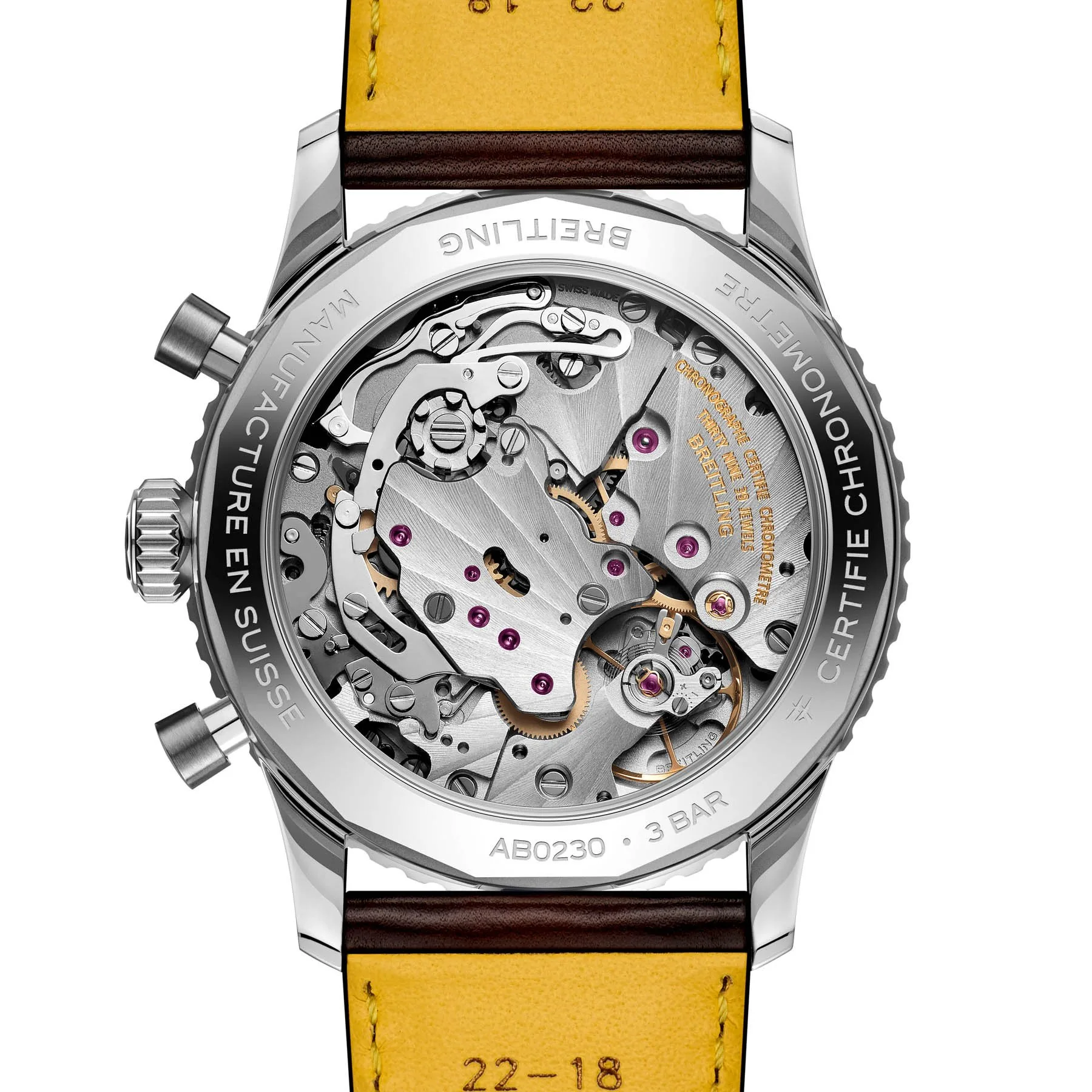
The Navitimer B09 Chronograph 41 is the purist’s pick: a reverse-panda dial in black or blue, white counters, white rehaut, no date, and the hand-wound Calibre B09 visible through a sapphire caseback — column wheel, vertical clutch, and some seventy hours of reserve. The inspiration is the reference 806 as worn by Jim Clark and Graham Hill, racing drivers who also happened to fly, which made the Navitimer’s circular slide rule rather more than cockpit decoration.

The second piece carries more altitude still. The Navitimer B02 Chronograph 41 Cosmonaute revives the 24-hour dial that astronaut Scott Carpenter requested of Breitling for his Aurora 7 orbital flight in May 1962 — a layout devised to tell day from night where neither exists, and the watch that became the first Swiss wristwatch in space. The new Cosmonaute runs the hand-wound Calibre B02 developed expressly for it, a COSC-certified chronometer with a date tucked discreetly into the lower counter.

Both watches share a 41mm stainless steel case, a 13mm profile, and the bidirectional slide-rule bezel that made the Navitimer a legend, with the Twin Jet rendered in gold on each dial. Most significantly, neither is a limited edition: these configurations, long rationed out as commemorative pieces, are now permanent residents of the core collection.
The B09 starts at €7,450 on calfskin, or €7,800 on the seven-row bracelet; the Cosmonaute from €10,000 on leather and €10,300 on steel. The 1960s, it turns out, never really ended — they were just waiting for re-entry.

